The house most likely to sit on the market in Arcadia this year is not the dated ranch with the popcorn ceiling and the 1962 kitchen. It's the finished, brand-new build a custom shop spent the better part of two years permitting and constructing. That runs against the instinct most buyers bring with them from other Phoenix neighborhoods, where new usually means fast, and old usually means a project. Arcadia inverts it, and the reason has less to do with taste and more to do with who's actually bidding on each type of house.
The Lots Move First
Original-condition homes in Arcadia, the kind still standing on their 1950s and '60s bones with the original citrus-era irrigation intact, typically go under contract inside a month once they hit the market. That's not because buyers love the popcorn ceiling. It's because builders are the ones bidding, and builders in Arcadia are chasing something the neighborhood has almost none of: buildable dirt.
Arcadia is fully built out, and the Arcadia Camelback Special Planning District exists specifically to keep it that way, preserving the low-density, single-family pattern the neighborhood was platted with nearly a century ago. That overlay is the reason supply doesn't expand to meet demand the way it does in newer Phoenix submarkets. The only path to a new house in Arcadia runs through an old one. A builder can't build up or build more; they can only build on top of what's already there, which makes an unremarkable original-condition lot the single scarcest input in the entire local market. When one comes up for sale, multiple builders are typically pricing the same teardown math at the same time, and cash settles it fast. Cash purchases run roughly 34 percent of Arcadia transactions overall, close to double the citywide Phoenix rate, and that share climbs above 50 percent once you get above the $3 million mark, where builders and move-up buyers with liquid capital dominate the bidding.
Renovated Resale Isn't Far Behind
The second-fastest lane in Arcadia is the renovated core, the updated kitchens and refreshed baths on quarter-acre irrigated lots that make up the heart of resale activity. Priced correctly, this inventory has been moving in under 45 days, and it's commonly trading within about 2 percent of list price. That tracks with a straightforward read of the buyer pool: someone shopping this tier wants the Arcadia address and the mature landscaping without taking on a construction timeline, and there are enough of those buyers circulating that a well-priced renovated ranch doesn't have to wait around for the right one.
Where the Market Actually Slows Down
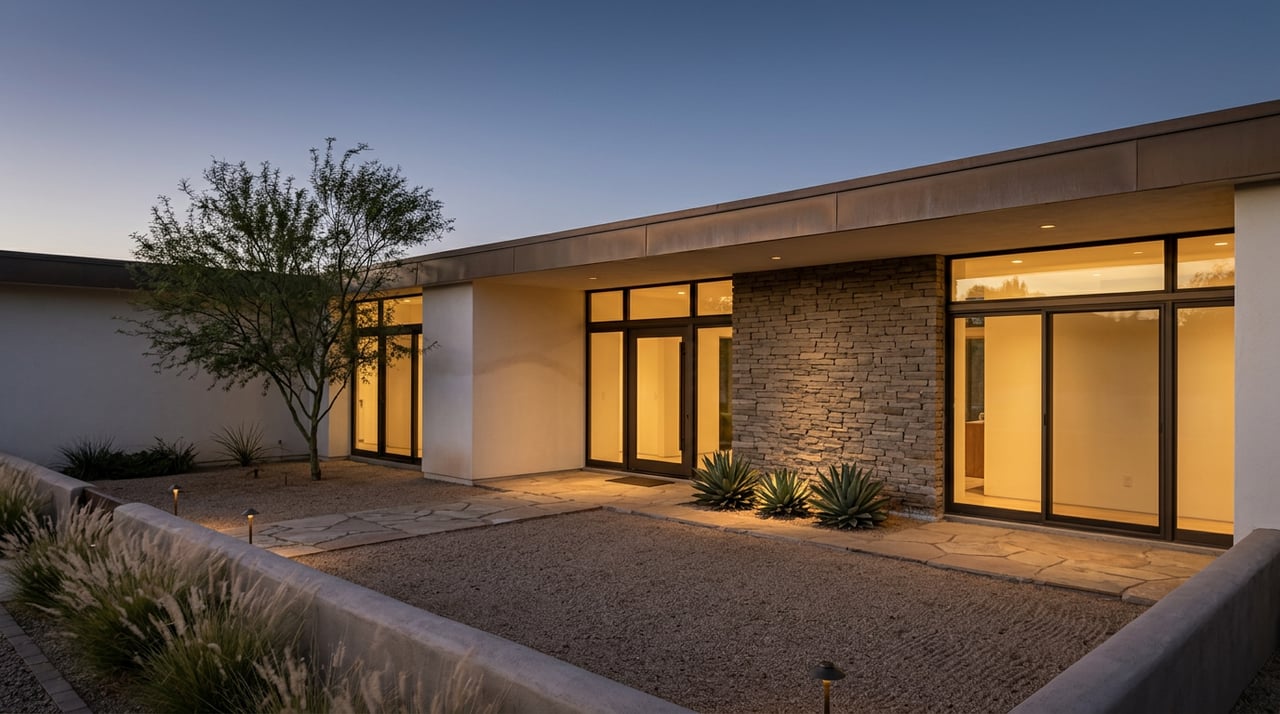
That leaves the tear-down rebuild tier, the custom new construction that lands somewhere between roughly $2.55 million and $4.55 million once the original house is gone and something new has taken its place. This is the segment absorbing the negotiation. Across recent closed sales, renovated homes have been trading within about 2 percent of list, while tear-down rebuilds have needed 6 to 14 percent off their original ask, often after one or two price adjustments, before they find a buyer. Arcadia's overall days-on-market average has been sitting around 74, and if original lots are clearing in under a month and renovated resale is clearing in under 45 days, the math on that blended average only works if something else in the mix is sitting considerably longer. The finished spec build is that something else.
It isn't hard to see why once you separate the buyer from the builder. The builder's economics depend on land cost plus construction cost plus margin, calculated the day they bought the teardown lot. But the finished product doesn't hit the market until 12 to 24 months later, on a permit-to-certificate-of-occupancy timeline that leaves plenty of room for the buyer pool to have shifted by the time the house is done. The buyer for a $3.5 million finished new build in Arcadia is a narrower slice of the market than the buyer for a $1.8 million renovated ranch, and that buyer is comparing the builder's asking price against other finished new construction, not against the neighborhood's median. A builder pricing to protect margin and a buyer pricing against comparable spec inventory don't always land in the same place on the first try, which is exactly what the 6 to 14 percent gap reflects.
What a Record Listing Says About the Incentive
None of this makes the top of that pipeline unprofitable. In September 2026, a newly built estate developed by the founders of Two Hawks Design + Build listed in Arcadia at $23.5 million, spanning roughly 9,388 square feet and built as the founders' own residence rather than spec inventory for resale. It's not a typical example of the tear-down-rebuild tier's mid-market friction. It's a demonstration of the payoff that keeps custom builders willing to absorb that friction in the first place. When a teardown-to-new-build project lands at the top of the market, the numbers can be extraordinary. That's part of why builders keep competing hard for original-condition lots even knowing the finished product in the $2.55 million to $4.55 million range will likely need more patience and more price flexibility than a renovated resale down the street.
The No-HOA Assumption Worth Checking
There's a related friction that catches buyers off guard regardless of which tier they're shopping. Most of Arcadia carries no HOA at all, which is unusual for a neighborhood at this price point and genuinely appealing to owners who don't want a board reviewing their remodel plans. But the Special Planning District overlay still applies. Fences, walls, and facade changes fall under its review even on a property with zero HOA fees. A buyer coming from a subdivision where "no HOA" meant no design oversight of any kind should confirm what the overlay actually covers before assuming a future addition or a new perimeter wall is a simple permit-and-build.
What This Means If You're Comparing Neighborhoods
If your search includes Arcadia alongside other central Phoenix or Scottsdale neighborhoods, the practical takeaway is less about the headline median and more about which of these three products you're actually shopping for. An original-condition home priced to reflect its lot value will move in weeks and will draw builder competition, so decisiveness matters more than negotiation room. A renovated resale priced correctly is also a fast-moving, near-full-price transaction. A finished new build or teardown rebuild is where a buyer has genuine room to negotiate, not because the house is undesirable, but because the pool of buyers for that specific finished price point is thinner and the builder's original number was set on a different market than the one the house sold into.
Arcadia's median sale price, which sat at $1,545,000 across 79 closings in ZIP 85018 in June 2026, is nearly four times the broader Phoenix citywide median, which has been running in the $460,000 to $485,000 range through the first half of the year. That gap is worth keeping in view, but it's the internal split, not the citywide comparison, that actually changes how a buyer should approach an offer here.
Frequently Asked Questions
Does Arcadia have a homeowners association? The large majority of Arcadia properties carry no HOA. A small number of private subdivisions within the broader footprint have minimal annual fees, typically $200 to $500, for shared road or common-area upkeep. The Arcadia Camelback Special Planning District still applies neighborhood-wide regardless of HOA status, and it governs exterior changes like walls, fences, and facades.
How long does a teardown-rebuild actually take in Arcadia? Most run 12 to 24 months from teardown permit to certificate of occupancy, depending on scope, custom design decisions, and approvals through the overlay district.
Why is Arcadia's median so much higher than the rest of Phoenix? Arcadia combines mature SRP-irrigated lots dating to its 1930s citrus-grove origins, a low-density preservation overlay that keeps new supply scarce, and proximity to Sky Harbor, Old Town Scottsdale, and the Biltmore corridor. Those factors don't exist together anywhere else in the city, which is why the neighborhood trades in a different bracket than the citywide median.
If you're weighing an original-condition lot against a renovated resale or a finished new build in Arcadia, the right offer strategy looks different for each one. Logan Lewis works this market closely enough to tell you which tier you're actually negotiating in before you write the offer.